

Trilateral hydrogen workshop: Australia, Japan, France
Sydney - 19.11.2025
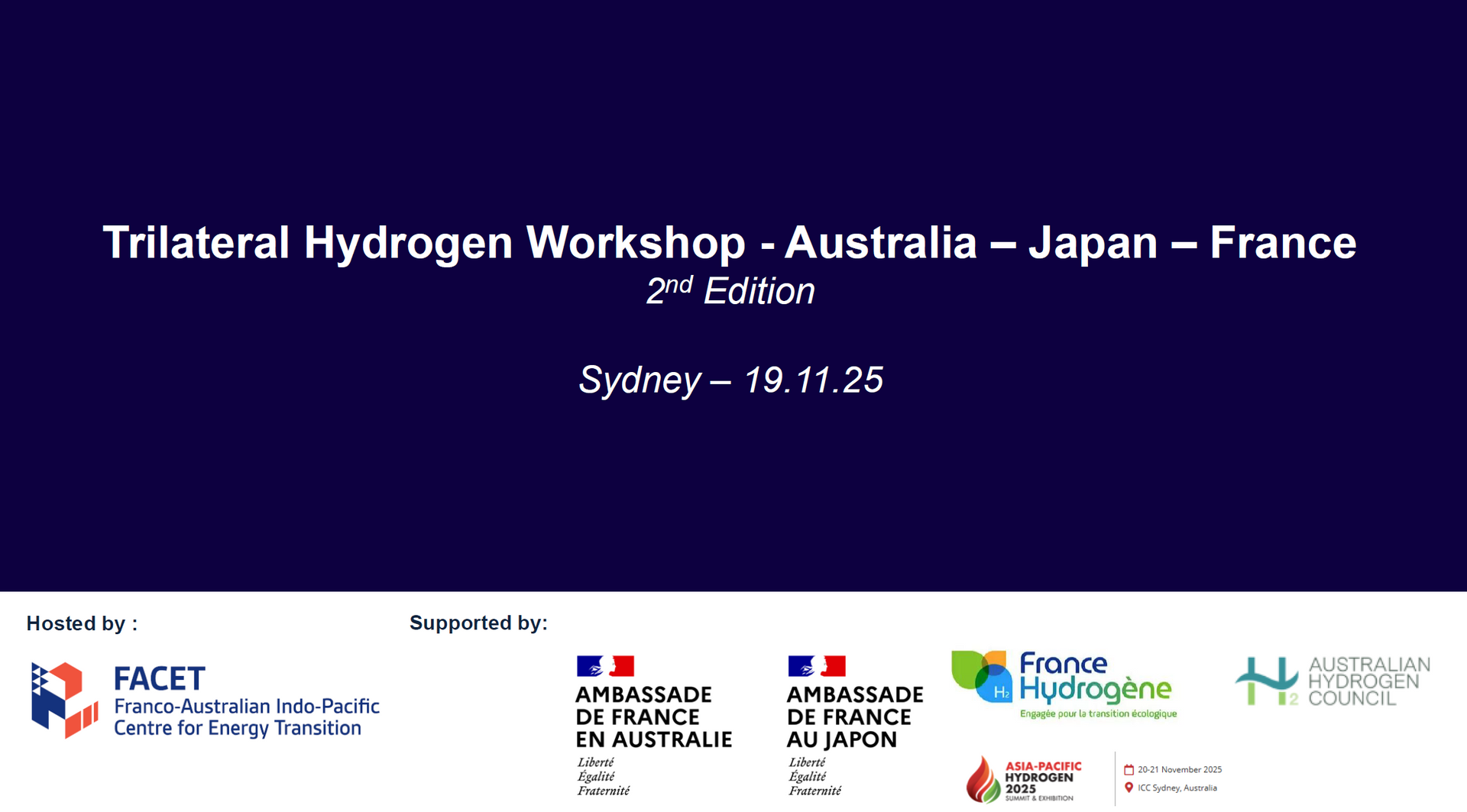
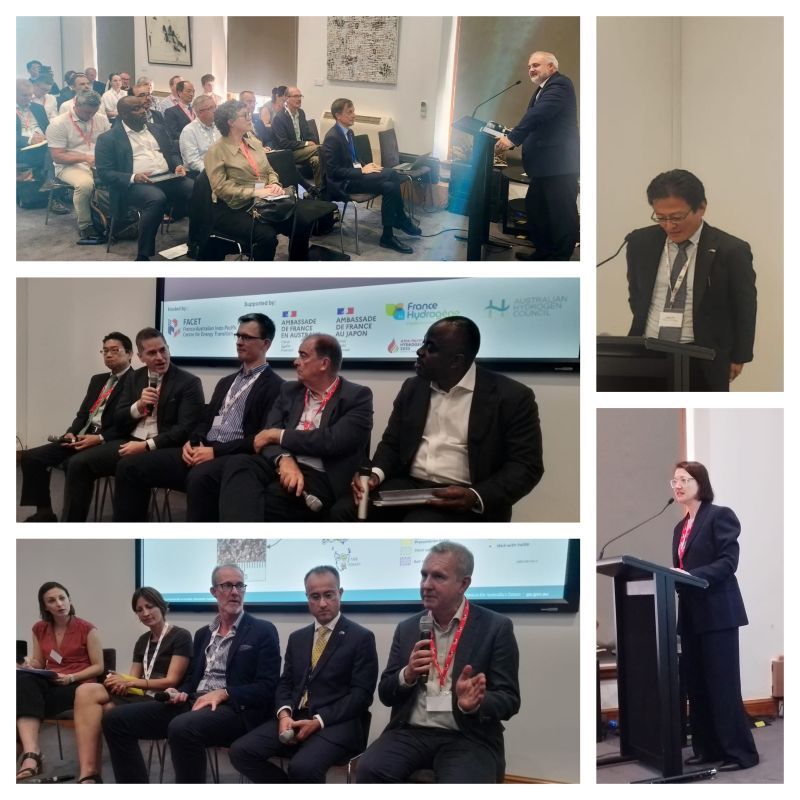
On 19 November 2025, FACET convened its second Trilateral Hydrogen Workshop, bringing together more than 50 senior government, industry, and research leaders from Australia, France, and Japan. Organized alongside the Asia-Pacific Hydrogen Summit, the workshop focused on two strategic themes: e-fuels and natural hydrogen, two strategic priorities seen as key drivers for fostering trilateral innovation and cooperation.
This article is a summary of the key discussion and learning points from the workshop.
Growing trilateral momentum since Tokyo 2022
The event took place three years after the inaugural workshop in Tokyo in 2022, which primarily focused on research. Since then, the hydrogen sector has evolved dramatically, with discussions now extending to investment, industrial deployment, and policy frameworks as Professor Julie Cairney, Interim Deputy Vice-Chancellor (Research) at University of Sydney reminded at the workshop.
Opening the event, His Excellency Pierre-André Imbert, Ambassador of France to Australia, emphasised the shared mission driving the partnership:
“France, Australia, and Japan are united by a common vision: a clean, sustainable, and secure energy future. […]. As we look ahead, we need to be guided by the conviction that the energy transition is not a race against each other, but a race against time - and one we can only win together. This workshop embodies the principle that no single country can decarbonize alone”.
The workshop began with an overview of the three countries’ hydrogen strategies and examples of how FACET initiatives align with national priorities.
Hydrogen strategies at a glance
- Australia updated its National Hydrogen Strategy in September 2024 introducing major incentives under the Future Made in Australia package, including a AUD$6.7 billion Hydrogen Production Tax Incentive and an expanded AUD$2 billion Hydrogen Headstart Program. Catherine Zerger, Head of Hydrogen Strategy and Industrial Futures Branch at the Department of Climate Change, Energy, the Environment and Water (DCCEEW) shared that Australia’s guarantee of origin scheme has just been legislated in Australia in Decembre 2024 and was just launched few weeks before the workshop. The Guarantee of Oigin is designed to verify the use of renewable energy and low emissions products. Under the Product Guarantee of Origin (PGO) side of the scheme, certificates will record the emissions intensity and key attributes of Australian made products like green hydrogen and metals. It also enables access to government incentives like Hydrogen Headstart and the Hydrogen Production Tax Incentive.
- France updated in April 2025 its hydrogen strategy reaffirming the role of hydrogen as a cornerstone of its carbon neutrality plan, targeting 4.5 GW electrolysis by 2030 and 8 GW by 2035. H.E Pierre-André Imbert, Ambassador of France to Australia highlighted that a key focus is on synthetic fuels, particularly for aviation and maritime sectors. By 2035, over 70% of hydrogen produced in France will be dedicated to e-fuel production and the government has already approved funding for advanced engineering studies on sustainable aviation fuels, backed by a €200 million commitment.
- Japan, under its Green Transformation Promotion Act, plans to invest ¥15 trillion over 15 years to build a robust hydrogen supply chain. According to Uehara Eiji, Counsellor, Economics Embassy of Japan to Australia, it is supported by the Japan Hydrogen Fund (JHF), which has already raised over US $480 million.
FACET new trilateral hydrogen project
- During the workshop, Katerina Aleksoska, General Manager International at the Australian Hydrogen Council, introduced a newly funded FACET project announced earlier in October 2025. The initiative seeks to unlock Australia’s green hydrogen export potential and strengthen supply chains linking Australia, France and Japan.
- It will examine the trilateral relationship as a strategic case study and will debut in January 2026 at the Hyvolution Paris 2026 | International Hydrogen Exhibition.
- The project will deliver a decision-support tool to help industrial consortia identify and position themselves for funding and project opportunities in hydrogen and hydrogen-derived industries.
E-Fuels: Opportunities for Trilateral Collaboration
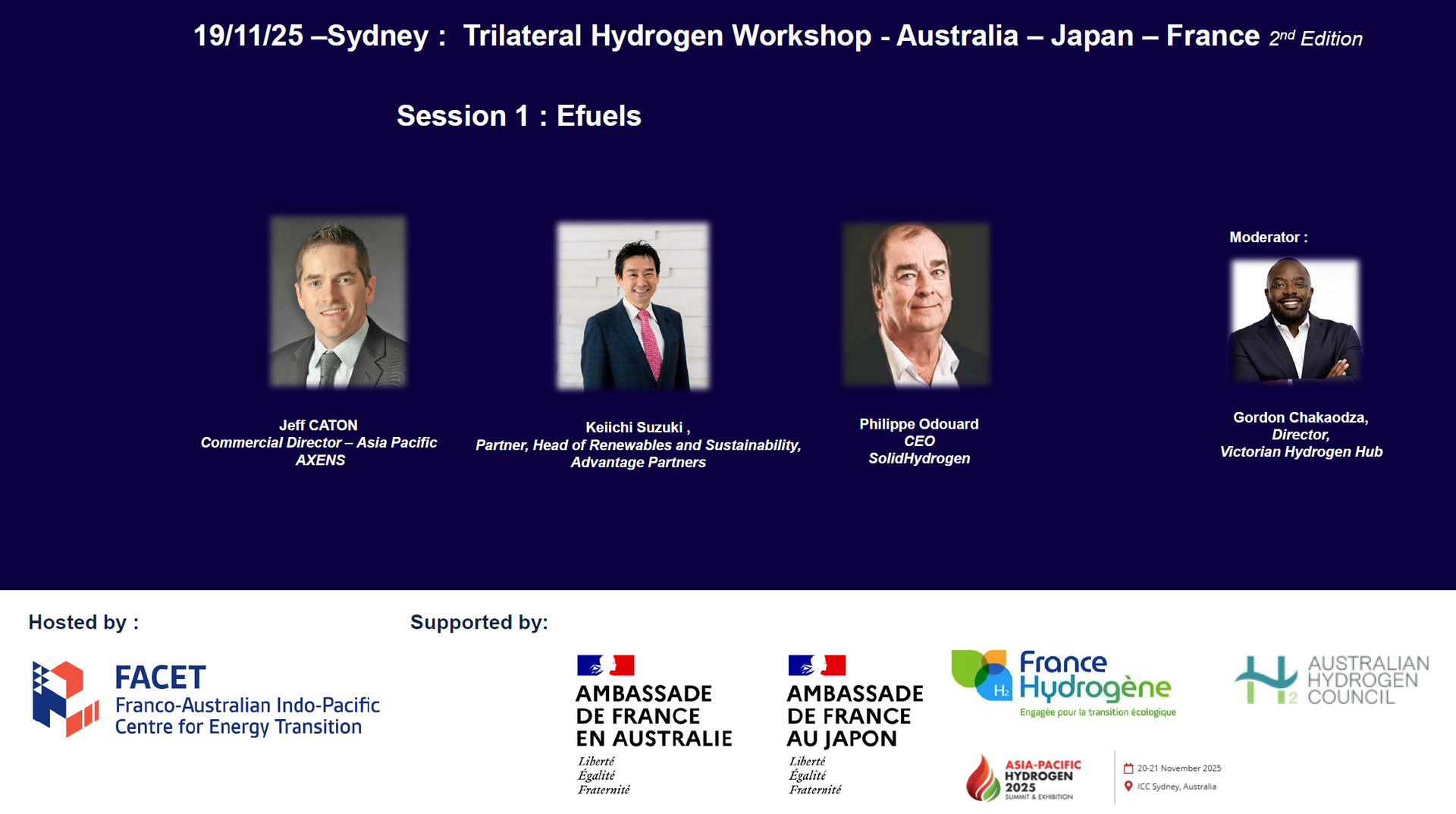
Moderated by Gordon Chakaodza (Victorian Hydrogen Hub), the e-fuels panel featured representatives from Axens, Solid Hydrogen, Downer Group, and Advantage Partners. Complementary national strengths emerged clearly:
- Australia: resource base and early-stage e-fuel project development
- Japan: strategic investment appetite and future offtake demand
- France: advanced technologies, modelling expertise and industrial R&D
Key insights from the discussion
Technology readiness of efuels:
- “Technical risk is no longer the main barrier. Processes are mature, and falling hydrogen costs will sharpen project economics” noted Jeff Caton, Commercial Director Asia Pacific at Axens.
Efuels and hydrogen Costs
- “A drastic reduction in hydrogen costs could be driven by breakthrough technological innovations” added Philippe Odouard, CEO of Solid Hydrogen
Investment opportunities in efuels projects in the APAC region
- “As Japan’s first dedicated hydrogen investment vehicle, the Japan Hydrogen Fund is accelerating the global hydrogen economy and has already highlighted international projects, including French ones, in its portfolio, including the Gravity clean iron initiative at Fos-sur-Mer (France)—a US$100+ million opportunity that underscores the fund’s commitment to industrial decarbonization.” Said Keiichi Suzuki, Partner, and head of renewables and sustainability at Advantage Partners
A unique opportunity of collaboration through FACET
- FACET funded a pre-FEED study for an Australian e-fuel demonstration plant, led by Downer Group, CEA and H2Potential.
- “This project is a strong example of trilateral collaboration, with developers already working with Japanese and French stakeholders on technology licensing and offtake agreements" said Ben Stieler, a Downer engineer involved since early 2025.
Policy needs in Australia in the efuels sector:
- All agreed that what’s needed now are clear policies and mandates to ensure stable offtake agreements and harmonized certification standard.
Insights from the natural hydrogen session
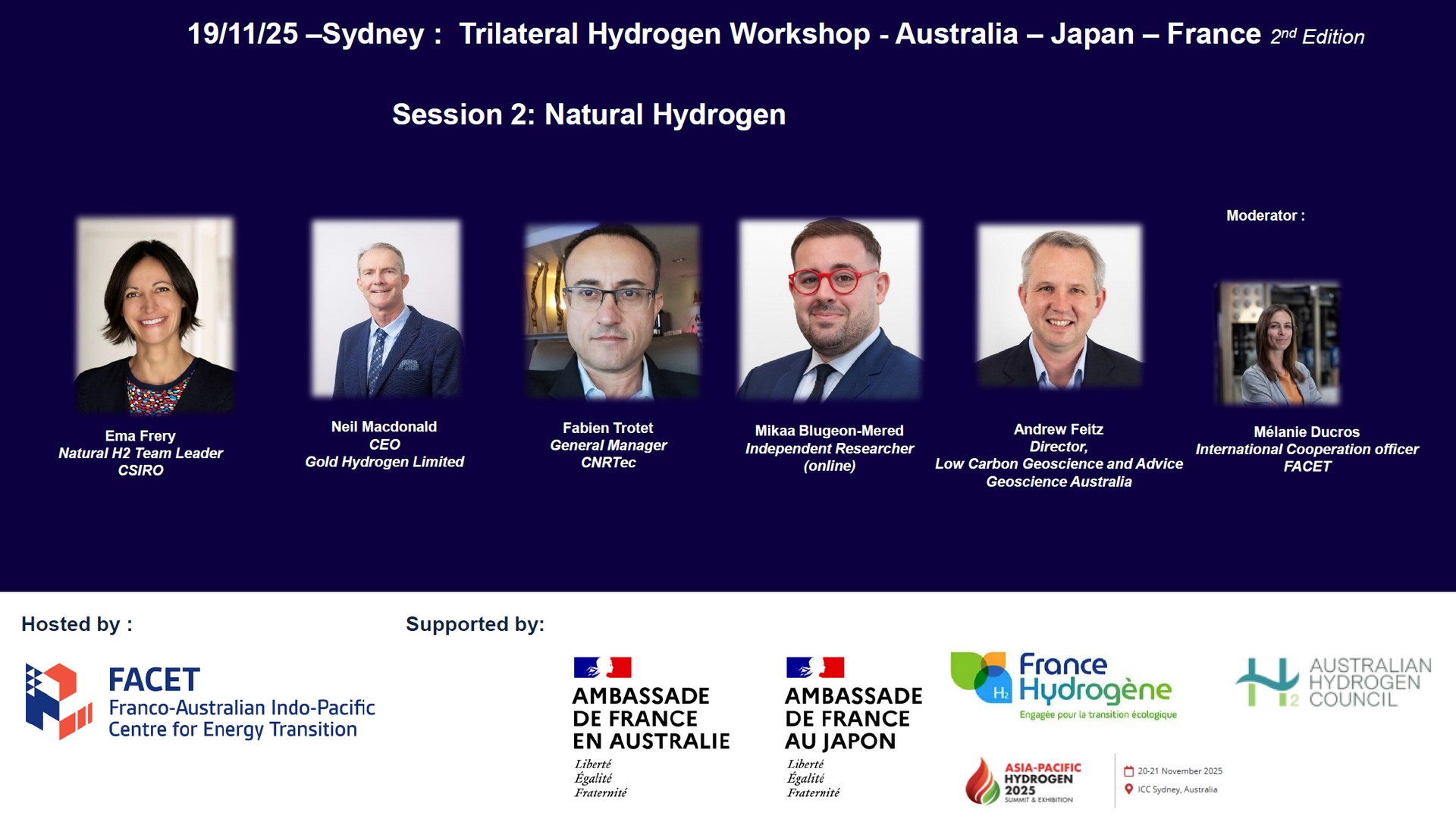
Moderated by Mélanie Ducros (FACET), the natural hydrogen session featured experts from CSIRO, Gold Hydrogen, CNRTec and Geoscience Australia. The discussion underscored growing momentum in this rapidly developing field.
- Australia is driving exploration through companies such as Gold Hydrogen, which has confirmed high-purity hydrogen and helium reserves in South Australia, attracting interest from Japanese investors, including Toyota and ENEOS.
- France is a pioneer in the sector of natural hydrogen, adapting its mining code in 2022 to include natural hydrogen as a recognized resource to provide a clear legal framework for exploration and extraction. It allowed France to grant three exploration permits already. France hosted the 2022, 2024 and 2025 editions of the H-Nat Summit, the world’s leading event dedicated exclusively to natural hydrogen. The only other country to host an in-person edition was Australia in 2023.
- Japan sees natural hydrogen as a strategic opportunity for long-term energy security, and this growing interest was evident in Novembre 2025 when a 30-organizations Japanese delegation visited Gold Hydrogen’s site in South Australia, one of the largest Japanese delegations to Australia in recent years.
Key insights from the discussion
- “Natural hydrogen has moved from scientific curiosity to industrial reality in just five years,” said Dr. Ema Frery (CSIRO), citing strong Franco-Australian scientific ties and significant government investment, including AUD$4 million in Queensland.
- Dr. Andrew Feitz, Director of Energy Initiatives and Advice at Geoscience Australia, outlined the agency’s role in Australia in mapping resources for a sustainable future. He presented findings from Australia’s first natural hydrogen study and ongoing work, assessing three underground storage options for hydrogen hubs: depleted gas fields, mined rock caverns (lined and unlined), and salt caverns. These studies reveal significant opportunities for trilateral collaboration, leveraging the complementary expertise of Australia, France, and Japan.
- Neil MacDonald, CEO of Gold Hydrogen, presented the company’s progress in exploration. Gold Hydrogen drilled two exploration wells in 2023, which were tested in 2024 and confirmed the presence of high-purity natural hydrogen and helium. This breakthrough has attracted strategic investment from Japanese companies, including Toyota, ENEOS, Xplora, and Mitsubishi Gas Chemicals. Japanese interest is growing rapidly.
- Fabien Trotet, General Manager of CNRTec, highlighted that natural hydrogen has been scientifically demonstrated in New Caledonia since 2022. The territory is now preparing to launch a call for tenders for natural hydrogen exploration, seeking partnerships with France, Japan, and Australia. Mining and metallurgy account for 77% of the territory’s electricity consumption, making access to low-carbon, sovereign, and cost-effective energy critical for competitiveness. If natural hydrogen were extracted locally, it could play a transformative role in ore processing, mobility, and metal reduction. From 2026 to 2028, the goal is to establish a regulatory framework and conduct detailed field surveys, supported by increased private investment, potentially from Australia and Japan. These steps will define prospects for development starting around 2029–2030, creating a clear window for trilateral partnerships to shape the future of natural hydrogen in the Indo-Pacific.
Conclusion
The workshop reaffirmed that France, Japan and Australia - through shared strengths in technology, investment, and resources - can position the Indo-Pacific as a global hub for hydrogen innovation.
“Collaboration is the key to unlocking the full potential of hydrogen and its derivatives,” said Tim Lester, Australia-Japan Business Cooperation Committee. “Together, we can lead the way.”
Echoing these remark Penelope Howarth, Senior Adviser and Energy Decarbonisation Focal Point in the Climate Change and Sustainability Division at the Department of Foreign Affairs and Trade (DFAT), finaly closed the discussions highlighting that FACET could be instrumental in advancing such collaboration.
Acknowledgements
For their partnership and contributions to the event, FACET extends its thanks to:
· Embassy of France to Australia
· Embassy of Japan to Australia
· Department of Foreign Affairs and Trade
· France Hydrogène
· Australian Hydrogen Council
· Asia-Pacific Hydrogen Summit & Exhibition
· Australian Department of Foreign Affairs and Trade
· Department of Climate Change, Energy, the Environment and Water
· The University of Sydney